**Mitch Albom Runs a Christian Orphanage in Haiti’s Gang-Ruled Capital**
In Haiti’s capital, Port-au-Prince, where armed gangs rule the streets and violence such as murder, rape, and robberies are common, bestselling author Mitch Albom has created a sanctuary. Have Faith Haiti, the orphanage he runs with his wife Janine, takes in some of the most at-risk children in the area.
From the outside, the orphanage looks like a prison, featuring 30-foot-tall walls topped with barbed wire and guarded by watchtowers. But inside, it is a haven for 56 children and employs more than 50 teachers and staff. The Alboms care deeply for abandoned infants, toddlers with disabilities, and children found begging on the streets.
“There are a lot of children right on the other side of that gate who are not wearing shirts or pants right now, and their bellies are swollen and they’re not eating. And that’s not fair,” Albom said. “If my wife and I can do anything to change that, even if it’s a drop in the bucket, that’ll be our drop.”
### How Mitch Albom Came to Run a Christian Orphanage in Haiti
Albom first arrived in Haiti in 2010 after a devastating earthquake killed around 200,000 people and left more than a million homeless. Although he is Jewish, he helped repair a Christian orphanage run by an elderly pastor.
The pastor told Albom, “I don’t have any money to run this place and I’m 84 years old.” Albom responded candidly, “Well, I could probably run it. How hard could it be?” Since then, the orphanage has been largely funded and run by Mitch Albom and his wife.
“We try to give them a childhood, which is stolen from so many of the people outside,” Janine Albom explained.
### Security Concerns at the Orphanage
Due to the dangerous situation in Haiti’s capital, international flights no longer land there. Each month, Albom flies to Cap-Haïtien and then boards a helicopter operated by a private security company to reach Port-au-Prince.
From the air, the city appears as a dense sprawl of chaotic streets and dilapidated houses. Once on the ground, Albom is driven by heavily armed guards in a convoy of bulletproof vehicles to the orphanage.
Since the assassination of President Jovenel Moïse in 2021, Haiti’s government has effectively collapsed. Approximately 90% of the area is controlled by gangs, and violence has displaced an estimated one million people, according to the United Nations.
Security is one of the biggest challenges for Yonel, the Haitian director of Have Faith Haiti. Yonel himself was left at the old orphanage 36 years ago as a 5-year-old. He regularly conducts surprise emergency drills where children grab “go bags” and rush to a concrete bunker equipped with steel doors, a generator, food, water, and surveillance cameras.
### Life Inside Have Faith Haiti
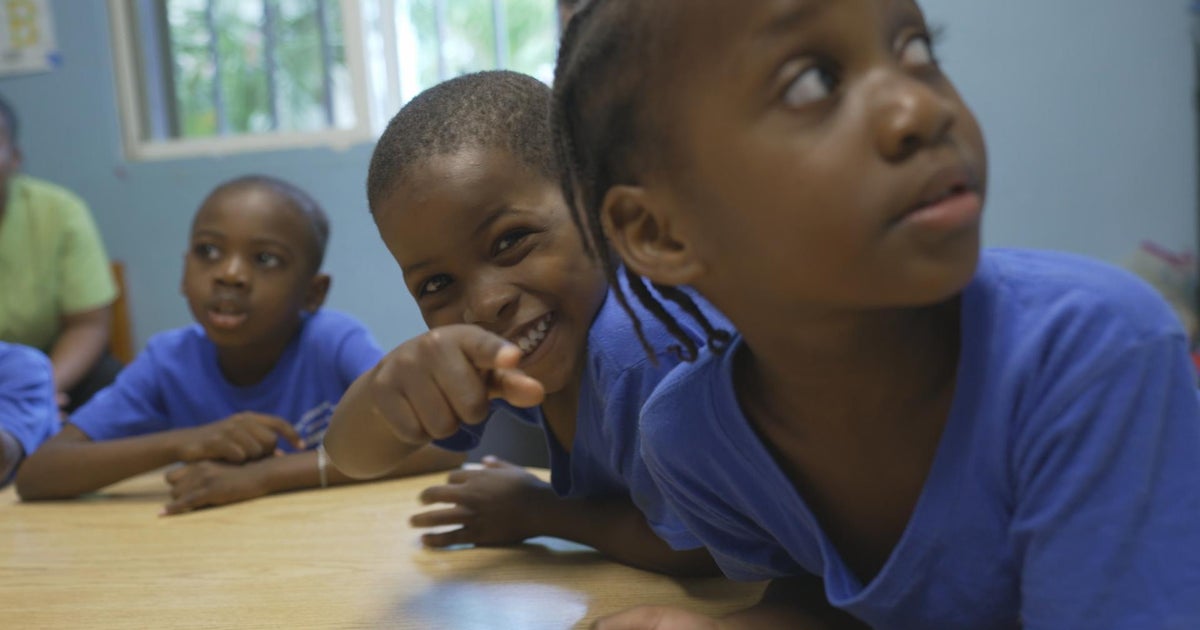
Beyond security, the orphanage focuses on love, faith, and education. Many of the children have not left the 7-acre compound in over four years. Within the walls, they play, do chores, attend church, and go to school.
Classes are taught in both French and English, preparing the children for potential college studies. “All children deserve to feel like they have a future and the future is possible,” Albom stated.
Not all children are orphans. Many are brought by desperate parents or relatives unable to provide for them. Albom explained, “We try to set the conditions because otherwise it’s hundreds and hundreds of children. We say, ‘only if there’s one parent, not two. Only if there’s no home, no actual structure home, or if there’s a case of sickness or something like that.’”
Seventeen-year-old Bettinie was brought to the orphanage as a baby after her father died in the 2010 earthquake and her mother was desperate. Lorvens, also 17, arrived malnourished at age three. Gina was given up by her father at age five.
“I felt abandoned,” Gina said. “I was a little bit scared because there were a lot of new faces and just a lot of people staring and smiling.”
Yonel, understanding the pain of abandonment, said almost all the kids call him “father.” “They need that connection,” he said. “So I put myself there for them.”
### Growing Up and Giving Back
Classes at Have Faith Haiti are small, and children struggling academically receive customized lesson plans. There are no cellphones, televisions, or personal computers for the children, allowing them to experience childhood in a “much purer form,” according to Albom. He noted, “Their attention span is remarkably long relative to American kids.”
Over the past eight years, sixteen students have graduated from high school at the orphanage, and all have received scholarships to study at American colleges and universities. However, these students agree to return to Haiti to work at the orphanage for two years without pay as a way of giving back to their community.
“They’re not going to America to take jobs,” Albom emphasized. “They’re not going to America to do anything but appreciate it and have an opportunity that they can’t have here, and then come back and make their country a better place.”
In December, Haitian college students Widley, Bianka, J. J., and J. U. spent their winter break at Albom’s home in Michigan. They expressed strong determination to help turn Haiti around.
“Education is one of the things I would really want to take back, and I will take back in Haiti because you need a better education to lead the government and to get a good job,” said Bianka.
Widley wants to pursue politics but recognizes the risks involved with Haiti’s unstable government, which has lacked an elected leadership since 2021.
### Haiti’s Uncertain Future and Hope for the Children
In September, the United Nations, with support from the U.S., approved deploying 5,500 international troops to aid the overwhelmed Haitian police. So far, fewer than 1,000 troops have been deployed, and the U.S. has cut its financial support to Haiti by over 50%.
Moreover, it remains uncertain how many of the orphanage’s older students will be able to study in the U.S., given visa challenges. Six students are set to graduate this spring; they plan to volunteer in Haiti for a year before applying for scholarships abroad.
Despite the challenges, there is hope. “Every child has that potential inside, no matter what circumstance they come from,” Albom said. “If you give them something beautiful and calm and hopeful, they’ll aspire to those things. And that’s what I think you see with our kids.”
https://www.cbsnews.com/news/running-an-orphanage-in-haiti-city-ruled-by-gangs-60-minutes/